Saturday, August 31, 2013

Thus to All Government Schools!


Is there a more destructive and untrustworthy institution than government? The world over, governments are responsible for barbaric atrocities committed on a daily basis. Even here in the "Land of the Free" we are surveilled, taxed, and regulated on a massive scale. The United States is responsible for killing untold numbers of foreign people while maintaining the world's largest prison population at home. They take your money and shower it on well connected corporations and the shiftless alike. They subsidize poor diets, promote harmful medical practices, wage immoral wars, outlaw voluntary activities, make it more difficult to produce goods and services, violate property rights, seek to disarm the public, and even attempt to regulate the sexual activity of consenting adults. And then they lie to your face about EVERYTHING. Go ahead and Google "politicians caught lying". See how long it takes you to browse through the 36,000,000 results. For all these reasons and many more, most people say they do not trust politicians. But then those same people will defend the existence of government schooling for children.

Why do we do it? Why do we allow the same stealing, cheating, killing bureaucrats to claim a right to molding our children's minds? My parents sent me to government schools and my oldest daughter attends a government school today. Part of the problem is that schooling is compulsory. And since taxpayers are forced to fund the government schools, whether they have children or not, the additional cost is much less if you choose a government school over a private school. Homeschooling is a good option, but with the Federal Reserve's never ending war on low prices (or deflation, as they call it), it is increasingly difficult to support a family on one paycheck. For my part, I am trying to make an effort to make sure my daughter is actually learning and encourage her to explore subjects she is interested in. I ask her what she is learning and I ask her opinions on what she is learning. My hope is that these conversations help her to learn to think, which is the most important task of any teacher. And parents, of course, are the most influential teachers a child has, for better or worse.

I was recently discussing this with a co-worker who couldn't disagree with me more. When I explained that I believe after a child is taught the foundation of learning -reading, writing, and arithmetic- they should then have an individualized education that is catered to their interests and aptitude, he literally laughed at me. He told me that all children must be taught the same things. He specifically used the example of the need for every 5th grader to learn the state capitals. I then challenged him to go quiz our mutual co-workers, high school graduates all, on the factory floor to see how many state capitals they could name. Perhaps all the time these people spent practicing their skills in rote memorization would have been better utilized for learning how to make a household budget and balance a checkbook. Maybe they could have learned about the value of savings and why it is necessary in order to improve your life. Maybe they could have put those skills to use right away by going to work and benefiting society rather than playing dodge ball.

So, not only are violent criminals (such as Barack Obama and George W. Bush) ultimately in charge of government schools and shaping the agenda of those schools, but we see that these schools also have a poor track record of actually educating children. Some would say that poorly educated students are exactly what the government desires to produce. I believe this is partly true in matters of foreign wars and the nature of the State itself. But I believe a large part of the problem is that the market is not allowed to work and discover solutions. There are many good teachers in these schools who are passionate about teaching. I personally had some good teachers (but not a single great teacher, though I don't doubt they exist). But what is a good teacher to do with a federal one-size-fits-all template for children who are each unique? What are they to do about the discipline cases who clearly do not want to be there and only serve to make it harder for everyone else to learn? A market would cater to the customers who in this case are the parents. There would be no universal template. There would be no teacher's union to protect bad teachers while not properly rewarding the good teachers. There would be no gang problems in schools because gangbangers would not be required to attend and could be expelled at any moment. Education would be what customers desire and at a desirable price.

The picture at the top of this page is of the old Fairmount High School in Fairmount, Indiana. It is the school that both James Dean and Garfield creator Jim Davis attended. It is literally crumbling to the ground. To me, it is almost the perfect illustration of the condition of learning in America. The main difference is that the state of education in America is yet salvageable. But not until we abolish government schools.

Wednesday, August 21, 2013

Battle Not with Terrorists, Lest Ye Become a Terrorist


“Battle not with monsters, lest ye become a monster, and if you gaze into the abyss, the abyss gazes also into you.” ― Friedrich Nietzsche

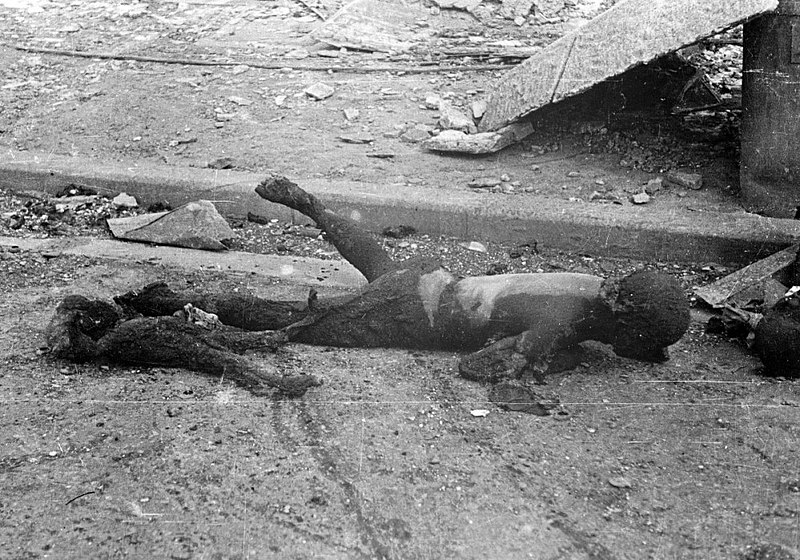
The above picture is a pile of corpses being readied for cremation in Dresden during WWII. These people were among the more than 22,000 victims of the infamous allied bombing of the "Florence on the Elbe". In high school I was shown a video of naked Jewish corpses being bulldozed into mass graves in Nazi concentration camps. I was never shown the piles of bodies created by U.S. and British bombing raids. The United States also killed over 100,000 people by bombing Tokyo. The bombardment of Tokyo is known as "the firebombing" because the paper city erupted into flames which killed far more people than the actual bombing. Here is the charred remains of a woman and her child:


The United States demanded that the Japanese Empire surrender unconditionally. This meant that the Emperor himself must be deposed. But the stupidly proud Japanese government refused to hand over the man they claimed to be a descendant of their god. So, the Americans dropped atomic weapons on defenseless men, women, and children; killing at least 150,000. (By the way, after the Japanese surrendered, they were allowed to keep their emperor anyway.)


There is no doubt that the Nazi government was evil. There is no doubt that the imperial Japanese government was evil. And there is no doubt that the U.S. government was and is evil. In 2006, the U.S. destroyed a school in Pakistan in order to kill the headmaster. 69 children were killed. That's more than were killed in Newtown, Connecticut and in a country we are supposedly allied with.

Dictionary.com defines terrorism as "the use of violence and threats to intimidate or coerce, especially for political purposes." It appears the United States is the world's largest and most dangerous terrorist organization. They have done battle with monsters. The abyss gazes into them.

Tuesday, August 13, 2013

Obedient Hands Serve the Mind


The mind moves the hand.
The hand is the means.
The end lies inside the mind.
The mind judges the ends.
The mind judges the means.
The hand obeys.

The mind must choose.
The foot can only tread one path at a time.
Means are forsaken.
The mind is mistaken.
The end is not reached.
Time to reassess.

The forsaken means
Are the costs of reaching
The ends the mind has chosen.
Satisfaction is the profit experienced when
Forsaken means are valued less than the accomplished ends.

Descartes thought and he was.
Beethoven played and I cried.
The Red King dreamed and Alice lived.
The mind creates and destroys.
The hand obeys.


Thursday, August 8, 2013

Knowledge is the Enemy of Tyrants


Recently I decided to start working my way through the Art of Manliness's 100 Books Every Man Should Read. I had already read several books on the list and enjoyed almost all of those, so I figured this would be a good excuse to reread them while also getting some new material. I also wanted to collect all of these works and place them on my bookshelf, so I decided I would purchase any book I don't already own rather than borrowing from the library. After rereading The Great Gatsby, I turned to the 2nd book on the list: The Prince by  Niccolò Machiavelli. I did not have a copy, so I checked online and found that I could get a copy for around $7 before shipping. But I was already waiting on another book I had ordered (not from the list of 100), so I thought I would try out the only local place that might have it: The Unorganized Bookstore.

I had never been to The Unorganized Bookstore and was only aware that they sold used books there. I was pessimistic about my chances of leaving the store with that book, but I figured at the very least I would have a chance to check the place out and see what it is they do offer. My family accompanied me to South Marion as my wife needed to stop by the grocery store anyway. We unloaded from the minivan, entered the bookstore, and were not there 5 minutes before my wife spotted exactly what I wanted. Actually, it wasn't exactly what I wanted. It was better! It was a hard cover copy of The Prince that also included Leviathan by Thomas Hobbes which is also on the list of 100! It was a volume in the Encyclopedia Britannica's Great Books of the Western World series. The series was originally produced in 1952, but this book looked as if it had never been opened. And the price of this glorious find? $2.

There were many great works by authors such as Homer, Plato, Aristotle, Thomas Aquinas, William Shakespeare, RenĂ© Descartes, John Locke, David Hume, Adam Smith, Immanuel Kant, Herman Melville, Count Leo Tolstoy, Fyodor Mikhailovich Dostoevsky, and Charles Dickens. A jackpot of knowledge. And all for either $1 or $2. Nearly everyone can afford to give themselves a top notch education of western philosophy at this price. But if that's too expensive, you can go to your local library. A few years ago, I went to the library in search of The Theory of Money and Credit by Ludwig von Mises. Not surprisingly, my small town library did not carry it. But they informed me that there is an in state library exchange and they were able to procure a copy for me. I used this same program to get my hands on books by Murray Rothbard, Henry Hazlitt, and Walter Block.

Too much effort to go to the library? The internet provides countless books for free. That's how I read Karl Marx's Communist Manifesto, Leonard Read's I, Pencil, and I don't know how many other essays and articles. You can learn math, science, and history with time and effort as your only costs. Heck, even Ivy League schools are offering free courses.

We live in a world where the cost of accessing priceless knowledge is diminishing to the vanishing point. The excuses for not being educated on important matters such as philosophy, psychology, the world's religions, finances, and economic theory are getting flimsier by the day. My advice to you: Read a book. And after you get done reading that, read another book. It doesn't have to be non-fiction. I always feel a bit wiser after reading Dickens or Steinbeck. And if you read with a dictionary by your side (or dictionary.com, as I do), you will find your vocabulary rapidly expanding. As George Orwell explained, language is thought. The more developed your language; the more developed your thought.

Knowledge is the enemy of tyranny and oppression. This is the reason it was made illegal to teach American slaves to read. The tyrant has a much easier time controlling the ignorant than the informed. Inform yourself. Don't be a slave. Read and think about what you read. Every human action is directed by ideas. Good ideas lead to a good society. Go find those good ideas.

Saturday, August 3, 2013

The Beauty of the Factory


Most people working on a factory floor probably don't stop to admire the beauty of the intricate process of which they are a part. At least, I've never heard any of my coworkers mention any such admiration. Then again, I don't believe I have ever expressed this feeling to any of them either but I feel it just the same. Perhaps they, like me, fear that no one else will understand.

It really is beautiful. I used to work at a factory that produced aluminum wheels for GM cars. Big bars of aluminum called ingots would be delivered to the facility. They would be placed in a giant vat that melted them into a shiny molten liquid to be poured into casting machines. The guys who ran the casting machines were typically burly men who withstood the insane heat for 8 hours at a time. The wheels would then be put on a conveyor and sent to the desprue operators. This is where the holes for the axle were cut or punched out. The wheels would then be hung on racks, 72 at a time, that were referred to as "trees" because of all the "branches". After this, the racks were placed in the heat treat and age ovens. This hardened the wheels so that they could better resist impact.

Depending on which wheel, they either next headed to the shot blaster (to add texture) or straight to Machining. The operators in Machining would slide the wheels off the rack and feed them to an encaged robot. The robot would cycle the wheels through 3 different lathes that cut all of the excess metal from the wheel. It would then return the wheel to the operator for some detail cutting with special tools. The fork truck driver would then move the machined wheels to Final Pack. They would be placed on a monorail that delivered them to rooms where they were primed and painted as they moved along. Eventually, they were taken off of the monorail, packaged, and shipped to assembly plants.

Where is the beauty, you might ask. The beauty is in every minute detail of the process. I am struck with awe as I consider that every conveyor belt, every bolt, and every air hose serves a purpose. Each tool, crafted in some other factory, has a job to do. I worked with men from a myriad of different backgrounds. I worked with men from Australia and Mexico. I worked with a heavily bearded man who chose to live without electricity. We were all brought together to cooperate with each other so that Americans could have wheels on their cars. As far as I know, none of us did this because we were passionate about aluminum wheels or automotive transportation in general. We were all enticed by a wage to produce for our fellow man. I can ascribe the same motive to the people who made the wool gloves I wore on the job, the people who sliced my lunch meat at the deli counter, and the electricians who wired the building. In all, there were millions -if not billions- of people cooperating to make those wheels. And it was the consumer, by use of the market, who directed each and every actor in this uncomprehendingly complicated process.

When consumers bid their dollars on scarce goods and services, prices form. Prices allow human beings to rationally decide what to make, how much to make, and how to distribute it. They are the indispensable tool of the market economy and, therefore, society. Entrepreneurs who please the consumer are rewarded with profits. Entrepreneurs who displease consumers suffer losses and are driven from the market. The resources that had been employed by them become available for the profitable entrepreneurs to use to continue satisfying the most urgent wants of the fickle consumer.

The wheel factory was eventually driven out of business. Chinese factories learned to produce the same quality wheels at a cheaper cost. This enabled them to offer wheels to GM at a much lower price than the American companies could compete with. The machinery was auctioned off and the laborers were released back into the marketplace where they sought the next highest bidder for their work. This too was beautiful.