It looks like local schools are being forced to experience what happens when the government imposes wage controls. The Affordable Care Act (ACA), popularly known as Obamacare, mandates that businesses with 50 or more employees provide an "affordable opportunity" at health insurance to all full-time workers, which the ACA arbitrarily defines as those above the 30-hours per week threshold. Schools are now finding that they must reduce the hours of teacher's aides and substitutes. Some will be losing their jobs.
And so it goes with all government interventions into the economy. Governments seem to be ignorant of economic law. That, or they are exploiting the economic ignorance of the citizens. They always offer a free lunch and, as we all know, there ain't no such thing. They act as if prices are random and can be changed at will without negative consequences. Perhaps if we understood how prices, including wages and compensation such as insurance, come about on the market, we would be less likely to allow them to meddle with them.
One of the main themes in economics is the investigation of how demand for goods and services is to be met by an adequate supply. For example: How can we make sure that enough food is produced and, once it is produced, how do we make sure it is distributed to all who need it? When there are people literally starving in places like the African and Asian continents, it is clear that something is not working. Supply is not meeting demand. But why? Why is the amount of poverty that is found in Western nations so minuscule when compared to that of the third world?
Prices are what balance supply & demand. Indeed, many economists say prices are where supply meets demand. And only on a free market, as Ludwig von Mises showed in his brilliant essay Economic Calculation in the Socialist Commonwealth, can true prices form. Let's say I am willing to spend $5 on a glass of lemonade (I must be really thirsty) and I know of a lemonade stand that will sell me a glass for that price just a few blocks away. But when I get to my destination, I see that a rival lemonade stand has set up shop across the street. This new stand is selling lemonade for $2.50. I can now get two glasses for what I would have spent on one. Or I can buy one glass and still have $2.50 left over to spend on something else. The demand for $5.00 lemonade plummeted as soon as someone offered it for $2.50. Unless the first lemonade stand offers a more competitive price, they will not be able to move their supply and they will be driven out of the market. But by lowering their price, they increase the demand for their product. Of course, prices are bid up by consumers vying for a glass of lemonade in the same way. If I offer $2.50 for a glass of lemonade, but the guy behind me in line is willing to pay $5.00, I must either pony up or bow out. The market price will be the result of this competitive bidding by both sellers and buyers.
Now let's imagine that the government intervenes. They decree that no one should have to pay more than $1 for a glass of lemonade. Even if we assume that lemonade is still profitable at $1 a glass, we still are heading for trouble. Why? Because supply & demand are about to be thrown out of balance. The lower price will increase demand. There will not be enough lemonade for everyone to purchase it at that price. You will have long lines of people hoping to get their glass before the supplier runs out. Also, with the lower price, profits will be reduced. Less profits means less entrepreneurs will be attracted to the lemonade market, which means that there will be a reduced supply. Supply decreases while demand increases. That's what we call a shortage.
Take away the price control and what happens? Prices are allowed to rise until supply meets demand. Supply increases and demand decreases. Everyone who is willing to pay the market price is able to acquire a glass of lemonade. So, when you see the vast areas of the earth where people can't seem to feed themselves, you should immediately suspect that something is wrong with their price system. Someone has intervened, if not with direct price controls, then by debasing the currency or being destructive of private property rights. For a sound currency and strong property rights are the necessary foundation of a free market and, as I noted earlier, a free market is necessary for the formation of market prices.
How does this apply to the wages of local teacher's aides? Wages are also prices. They are the price of labor. Employers will compete against each other to bid wages up to the maximum level they can pay and still profit. If an employer is paying a wage of $10 an hour while making $15 an hour from that employee's production, then another employer will see an opportunity to undercut the first employer and still make a profit by bidding $11 an hour. It should be becoming clear by now why government intervention cannot improve upon this arrangement.
The Affordable Care Act demands that employers increase the wages of "full-time" workers by way of paying for their insurance. But the law does not call new resources into existence. It is merely redistributing already existing resources in a manner the government prefers instead of the manner that the market prefers (the market being you, me, and everyone who exchanges goods and services). The increased price of school employees by federal edict has reduced the demand for their services. Supply & demand will always balance, one way or another.
Apply this same logic to the FDA, EPA, OSHA, or the Department of Education, and you will soon wonder if the federal government is worth the price you pay.
Monday, June 24, 2013

Friday, June 14, 2013
Don't Worship the Federal Flag
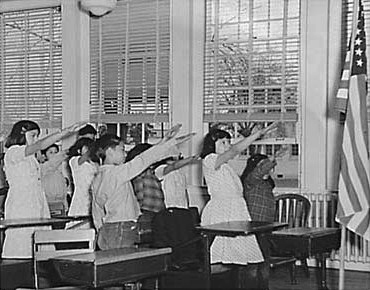
As I was driving home from work early this morning, a reporter on the radio was announcing that Syria had crossed a "red line" and that Barack Obama has decided that we should (overtly) send weapons to the men who are doing battle with the Assad regime. I looked out the window and saw American flags lining Main Street. My blood began to boil. As the federal government dives into yet another armed conflict in the Middle East, another regional dispute that's outcome has no bearing on the typical American's life, our cities and towns are celebrating that government by displaying its star spangled banner with pride.
Once upon a time, I adored that flag. I had been taught to pledge my allegiance to that flag as a child. It stood for freedom and capitalism and general awesomeness. As far as I was concerned, the good guys carried that flag and everyone else was inferior if not evil. But now I see it for what it really is. It is nothing more than the logo of the empire and, since September 11th 2001, has come to be nearly ubiquitously associated with support for the empire's wars. It has also been transformed into a sort of religious symbol. We are told not to desecrate it. We are expected to stand with our hands over our hearts and face it as the federal anthem plays.Why on earth would we ever want to worship this symbol of our tyrannical federal government?
Perhaps you don't find the federal government to be particularly tyrannical. Perhaps you don't mind universal warrantless searches of phone records and email accounts. Perhaps you don't mind the IRS targeting political dissidents (political dissident being defined as someone who promotes the Constitution). Perhaps you don't mind the enormous tax burden they place on your shoulders. Perhaps you don't mind that they borrow money on your credit (the promise to tax you even more) and won't be able to pay it all back. Perhaps you don't mind them groping your genitals at the airport, dropping bombs on foreign children, sending your friends and family off to die in pointless wars, wasting resources on drug prohibition, destroying the healthcare market, subsidizing giant corporations, and constantly pumping fiat money into the economy causing recessions and depressions. Perhaps you don't mind them taking your money and bailing out irresponsible bankers instead of prosecuting them.
If you support the ideas of liberty, justice, and peace, then you should not be saluting the U.S. flag. You should be burning it.
Wednesday, June 5, 2013
Seybold Hopes to Ride River of Red Ink to Indianapolis
The rumors have finally been confirmed. Marion Mayor Wayne Seybold, evidently not satisfied with ruining only Marion's finances, will be running for Indiana treasurer in 2014. Surely, I thought, no one else will think this is a good idea. But then I read the reports by the Chronicle-Tribune and the Associated Press and found that Republicans Brad Luzadder, Dan Dumezich, Bob Grand, Dan Burton, Murray Clark, Rex Early, and Mike McDaniel all think he would make a swell treasurer. We would be fortunate if that list represents Seybold's supporters in their entirety.
Wayne doesn't really seem to have a knack for staying within a budget, to put it mildly, so why is he so interested in running the state's finances? There has been speculation that he is merely using this as a stepping stone to higher office. Many felt that is also why the current treasurer, Richard Murdock, ran for this office. Of course, his effort to obtain a U.S. Senate seat was derailed by his choice of words concerning the "legitimacy" of some rape cases. Seybold himself has already ran for higher office but was defeated in the Republican primary for the Fifth Congressional District seat. The winner of that primary, as well as the winner of the general election, was Susan Brooks.
I am not a resident of Marion. But I am a resident of Indiana. I have enjoyed laughing at Marion for keeping Seybold around and letting him use taxpayer money to fund crony-capitalist boondoggles and hiring his buddies for city jobs. But if he becomes treasurer, he will get an opportunity to waste my money. Things just became personal. I'll have you know that my city, county, state, and federal governments already do an outstanding job burning through the money I make every year, Wayne. I know you think you could waste more and, by God, you're probably right. But I would prefer you keep your grubby little hands in your own (empty) pockets.
What kind of person aspires to high government office anyway? And what kind of person actually succeeds in our corrupt political system? To answer the first question, St. Augustine warned of the Libido Dominandi, or "lust to dominate". Some people just have an insatiable lust to rule over their fellow man. They seek power for its own sake or perhaps as a means to reshape the world so as to be more inline with their personal vision. But there is at least another type of person who dreams of holding office. Some people see the opportunity for graft and can hardly resist the idea of enriching themselves via the public trough. They see the seemingly limitless opportunities to use influence and political power in order to pursue personal wealth. If I had to guess which of these personality types best describes Seybold, I would choose the latter.
I ask again: What kind of person actually succeeds in our corrupt political system? F.A. Hayek argued in his legendary political book, The Road to Serfdom, that socialism necessarily gives rise to brutal leaders. Since violence must be used in order to stop people from making unsanctioned exchanges, he who has the least qualms about using violence against his fellow man quickly accrues power. But why should this be any different in a quasi-democracy like ours where those without vote for candidates based on what they will loot from those who have and "redistribute" it more "equitably"? Those more willing to take from the majority for the benefit of some minority group, be it a favored ethnic group or some business interest, find themselves reelected time and again.
Wayne Seybold has done a poor job managing the city of Marion's money. There is reason to suspect that he has his heart set on gaining a more powerful position than mere treasurer. Whether he is elected to the position or not, it is certain that we will have a total creep running the finances in Indiana.
Wayne doesn't really seem to have a knack for staying within a budget, to put it mildly, so why is he so interested in running the state's finances? There has been speculation that he is merely using this as a stepping stone to higher office. Many felt that is also why the current treasurer, Richard Murdock, ran for this office. Of course, his effort to obtain a U.S. Senate seat was derailed by his choice of words concerning the "legitimacy" of some rape cases. Seybold himself has already ran for higher office but was defeated in the Republican primary for the Fifth Congressional District seat. The winner of that primary, as well as the winner of the general election, was Susan Brooks.
I am not a resident of Marion. But I am a resident of Indiana. I have enjoyed laughing at Marion for keeping Seybold around and letting him use taxpayer money to fund crony-capitalist boondoggles and hiring his buddies for city jobs. But if he becomes treasurer, he will get an opportunity to waste my money. Things just became personal. I'll have you know that my city, county, state, and federal governments already do an outstanding job burning through the money I make every year, Wayne. I know you think you could waste more and, by God, you're probably right. But I would prefer you keep your grubby little hands in your own (empty) pockets.
What kind of person aspires to high government office anyway? And what kind of person actually succeeds in our corrupt political system? To answer the first question, St. Augustine warned of the Libido Dominandi, or "lust to dominate". Some people just have an insatiable lust to rule over their fellow man. They seek power for its own sake or perhaps as a means to reshape the world so as to be more inline with their personal vision. But there is at least another type of person who dreams of holding office. Some people see the opportunity for graft and can hardly resist the idea of enriching themselves via the public trough. They see the seemingly limitless opportunities to use influence and political power in order to pursue personal wealth. If I had to guess which of these personality types best describes Seybold, I would choose the latter.
I ask again: What kind of person actually succeeds in our corrupt political system? F.A. Hayek argued in his legendary political book, The Road to Serfdom, that socialism necessarily gives rise to brutal leaders. Since violence must be used in order to stop people from making unsanctioned exchanges, he who has the least qualms about using violence against his fellow man quickly accrues power. But why should this be any different in a quasi-democracy like ours where those without vote for candidates based on what they will loot from those who have and "redistribute" it more "equitably"? Those more willing to take from the majority for the benefit of some minority group, be it a favored ethnic group or some business interest, find themselves reelected time and again.
Wayne Seybold has done a poor job managing the city of Marion's money. There is reason to suspect that he has his heart set on gaining a more powerful position than mere treasurer. Whether he is elected to the position or not, it is certain that we will have a total creep running the finances in Indiana.
Subscribe to:
Posts (Atom)